Who needs a bucket list?

How many times have you heard someone ask, “What’s on your bucket list?”

I’ve always been a fan of lists (not necessarily the ‘bucket’ variety…but lists). I find that writing something down tends to make my goals real and tangible and to hold me accountable. Also, it helps with remembering things. But that’s another story.

So, how about a bucket list? Do you have a list of things you want to do before you 'shuffle off this mortal coil'?

This is a concept so deeply ingrained in our current culture that there are multiple self-help books and websites dedicated to helping you create your own bucket list.

You don’t have one? No worries. You won’t have any trouble finding friends and family (along with those books and websites) who’d love to build or expand your bucket list. They’ll come up with things like visiting the Seven Wonders of the World, climbing the Swiss Alps, spending a week in a Buddhist monastery in Bhutan or at an all-inclusive resort in Bali, etc. Things to do before you die that will push your limits or broaden your horizons and help you live your best life...more or less.

  • Well, Jim and I don’t have a bucket list. Now, why is that?
     Because in the course of working and raising our children, we wrote and we wrote and we wrote. Writing was something we could do together, help pay our bills with, and even ‘live’ the adventures of our characters. And we got to see a bit of the world through our research and the conferences we attended. We loved and still love what we were doing.

  • Because for many people, making a bucket list has come to incorporate one-upmanship.

  • Because no two people see life the same.

 What does that last point mean? How many times does someone recommend and really pump up a book, a movie, a vacation package? Then, you take the recommendation and go into it with high expectations, only to be disappointed. Basically, your experience does not live up to what you imagined it would be. Now, if you read that same book, watch that same movie, or go on that trip without all the buildup—with only the mindset that I’m going to enjoy this, for there’s no high expectations—then the chances are that you’ll really enjoy that experience.

Now, are there places we’d like to visit some day? Yes, absolutely. Are there things we’d like to do that we’ve never have done before? Yes, for sure. Do we make a list of them? No. Especially not now.

These days, my bucket list couldn’t even include going to the dentist for my semi-annual cleaning. My oncologist finds that too compromising for my condition.

I recently read this passage in a Psychology Today article: “Building up the items on your bucket list in a way that your life is not complete [without them] is bound to leave you disappointed.”

No disappointments here. My life is complete, and I have so much to be thankful for. But Jim and I are definitely interested in going on spontaneous (and planned) getaways…oncologist permitting. Bali and Bhutan are not in the cards, but we might take that road trip up the Pacific coastline…

How about you? Do you have a bucket list? What do you think of it?


A friend has been kind enough to set up a GoFundMe fundraiser.

Here is the link to that page.

Thank you!

The Giving Tree...and the Tree that Fell from the Sky

Jim and I have always been tree lovers (at risk of being called ‘tree huggers’). And we mean that in the literal sense of word. Every house we’ve lived in, we’ve always planted a tree, or at least had a tree adventure.One of the favorite books we used to read to our sons when they were younger was The Giving Tree by Shel Silverstein. Regardless of how many times we read that book, I always sobbed through the very last page.

Did I mention tree adventures?

There was a giant mulberry tree at our first house in Westerly, Rhode Island. Before we moved in, it was scheduled to be cut down. Hundreds of birds sat on that tree, ate the colorful berries, and then proceeded to poop on the neighbors’ cars. It took some friendly interaction from us – followed by cooking and delivering mulberry jam every year – to save that old tree’s life.

When we bought our home in the Point section of Newport, RI, the courtyard shaded by our white lilac became the fragrance-filled gathering place for countless neighborhood get-togethers.

The apricot tree we planted in our house in Perkasie, Pennsylvania, was a source of great amusement for the neighborhood kids. When it started bearing fruit, they looked like bees working around the hive. (The Shakers had a saying about the importance of growing enough for the neighbors too!) The kiwi wasn’t as successful, but we did have some luscious-looking branches.

And then there was the gigantic weeping willow tree in our backyard in Connecticut where our sons and their friends played volleyball and basketball for days on end. There was even a mini-tornado that brought down spruce and white pines along the property border, but the weeping willow survived.

Of course, soon after moving to California, we had to plant our pomegranate and avocado trees. Our granddaughter harvested two pomegranates this past month. And there are more than a dozen still growing on the tree!

In each case, with all of the planting and occasional pruning, we’ve done our share of sweating, hard digging and constant attention. We’ve had days of pondering whether the hole was deep enough or if the soil was fertilized enough. Once we considered if we should remove a boulder three feet down. But when it's all said and done, our trees have given us so many days of fun and conversation and adventure...and an occasional piece of fruit. (-:

But this week, we got an entirely new view of how someone else approaches the job.

A house recently purchased in our neighborhood had a half dozen VERY large, mature trees and at least a dozen shrubs planted yesterday. It took the workers less than a couple of hours. And how did they get it done? Take a guess after looking closely at the photo we took from our kitchen window. We're talking about seriously large equipment! Yes, that's the mother of all cranes in the left corner.

The couple moving in undoubtedly paid a great deal of money for this lightning quick landscaping...and that's great for them. But we still prefer the memories of our own giving trees much better than the tree that fell from the sky.

The Doctor in the House

This post is as much about the love of my life, Jim, as it is about me. And for those of you who know us well, there’s some things here that YOU don’t even know.

To begin, Jim knows facts. His incredible brain is packed with information, much of it random. Ask him anything and he knows the answer. If he doesn’t, he’ll never admit it. He just makes it up. Then, he goes on Wikipedia and makes a page for it...or doctors up a page that’s there. One time, we were talking about a 19th century writer. Jim said he was a recluse, and when he died, his dogs ate him before the authorities broke in and found the body. Ten minutes after our discussion, Jim showed up with a printout of the Wikipedia page “proving” it. Well, he doesn’t do that anymore...not since I reported him. ;-)  

But honestly, he’d be a perfect candidate for Jeopardy.

Some years into our marriage, before our writing career took off, Jim went and got his PhD while I was working as an engineer. Right out of graduate school, he got a job teaching college in Pennsylvania. After that, the mail that came for him was generally addressed to ‘Dr. James McGoldrick’.

The first challenge to Jim’s doctoral status came from our mailman who stopped him one day by the mailbox. The man wanted a second opinion on some over-the-counter medication he was taking for an illness. Jim politely said that he should consult his own doctor.  

The mailman (disappointed): “What kind of doctor are you?”

Jim: “A word doctor.”

The mailman then proceeded to show Jim a suspicious mole on his nose. Our mailman was sort of hard of hearing.

It was right about then that I started saying that we have a doctor in the house. It actually started right after I bought Jim a book about Reflexology and Acupressure. Of course, he memorized it all after one reading.

From then on, from bumps and bruises to colds and stomach aches, our boys grew up running to Pop to fix it. They trusted him to have answer to any illness in the universe. Again, if he didn’t know the answer, he’d either look it up...or make it up. Somehow, the boys survived.

Fast forward to 2003, the first time I was diagnosed with breast cancer. (And no, Jim was not allowed to open up either the Reflexology book or Wikipedia.) However, my oncology team at Yale/New Haven Hospital believed that a patient benefits greatly with a wide range of complementary therapies. A dear friend of mine, a Reiki master, drove all the way from Rhode Island to Connecticut numerous times to administer Reiki to me during course of my treatments. Well, Jim watched closely and started reading up on it. Pretty soon, I was reaching out to him for the Reiki. Needless to say, my sweetheart’s reputation grew (both in our household and amongst the local letter carriers). Not only did he know facts, now he practiced complementary medicine (without a license...but don’t report him; the statute of limitations has run out.).

That brings us to now.

All of you who have been following our blog know that I went through four months of testing, with inconclusive results. The imaging tests—like MRI, PET and CT scans—were mostly clear but I continued to have medically unexplained symptoms. I was sick, and I knew I was sick. Thankfully, I wasn’t brushed off by my doctors. My oncologist said at some point that something was definitely wrong, but to pinpoint it, a biopsy was needed. So they went in, found something “concerning” on the kidney. But the results came back, “Nada.”

When my team of doctors came up with the suggestion that since they couldn’t find anything, they’d repeat such-and-such a test in three months, I reached for my in-house doctor. The two of us rolled up our sleeves and went to work. If there’s one thing we know how to do, it’s research. And I do live with a human encyclopedia.

We both knew the Internet is filled with misinformation, especially about cancer diagnoses and care. But at the same time, one can find research articles such as this one from the MD Anderson Cancer Center in Houston:  https://www.mdanderson.org/cancerwise/What-is-invasive-lobular-carcinoma-8-insights-on-lobular-breast-cancer.h00-159539745.html

“Lobular breast cancer spreads to the gastrointestinal and urinary tracts. Lobular breast cancer tends to spread to unusual sites, such as the lining of the gastrointestinal and urinary tracts. Patients often notice they feel constipated or have changes with urination. Like in the breast, the cancer cells grow linearly and cause these tracts to narrow. It’s like a lasso that tightens over time. Because the cells grow in sheets and not a mass, metastasis is also difficult to detect.”

I had Lobular Breast Cancer nineteen years ago. All my recent troubles have been gastrointestinal. After more research, we learned that imaging wouldn’t identify Invasive Lobular Cancer (ILC).

What did we do next? Made appointments with doctors outside of our team. And couple of weeks later, exploratory surgery found the cancer. Yes, MD Anderson’s article was correct.

Did we diagnose my situation before the doctors did? Certainly not.

Were we proactive in terms of making sure no stone goes unturned? Yes.

Did I have a great doctor in the house? Absolutely.

And the day we sat down with my oncologist to go over the treatment plan, Jim and I pulled our chairs up to the table. The conversation was respectful, with relief all the way around. We knew how hard the team worked to diagnose my cancer, and they knew that I—with Jim beside me—was going to be a hands-on and educated patient.

Since then, I’ve seen how closely Jim paid attention to things when the nurses worked on the port on my chest. And how he watched the dozens of needles going in during my acupuncture session.

I wonder what’s running through his head… 


A friend has been kind enough to set up a GoFundMe fundraiser.

Here is the link to that page.

Thank you!

To Pseudonym or Not to Pseudonym: A Question of Lying (and Usefulness)

George Orwell was a big liar. So was George Elliot. And Dean Koontz. And all three of those nefarious Brontë sisters. And Mark Twain. And Agatha Christie. And George Sand. And Nora Roberts, of course. And that most insidious of liars, Dr. Seuss.

So was Jane Austen, though to a lesser extent. When Austen’s novel Sense and Sensibility came out in 1811, the phrase “By a Lady” was printed in place of her name on the title page. Anonymity was important at the beginning of her career, even though her authorship later became an open secret. But why not divulge her real name? Was it protection for herself or her family, was it the importance of propriety, or was it business?

All of the authors mentioned above are examples of writers who have used pseudonyms. Some of those pen names are actually the names we know them by. Okay, using a pen name is not exactly lying. There are lots of reasons for using them and “hiding” one’s identity.

George Orwell wanted to save his legal name for when he did his “serious” writing. Sand and the Brontës and Elliot and Austen were publishing at a time when it was difficult for women to get into print, never mind being taken seriously as writers. Or they wanted to protect their families or themselves, for a variety of reasons. Roberts and Koontz and Christie wanted to tell stories in other genres. Theodor Geisel was banned from submitting stories to the school newspaper for some infraction, so Seuss was born.

We’re liars too. When we published our first historical romance, the publisher insisted that we use a feminine pseudonym for business purposes. They even went so far as to invent a bio for us in the book that said something to the effect that “May McGoldrick lives in Bucks County, Pennsylvania, with her cat, where she is working on her next novel.” No picture. Our real names didn’t even appear on the copyright page.

That was okay with us. We were delighted about being published. Plus, those first books were romance, at that time the “infamous shady lady” of literature. Nikoo was working as an engineering manager with men reporting to her. Jim was teaching at a Catholic college. Oddly enough, our fiction turned out to be no problem there. The college administration embraced the novel, and we found out that the chaplain was even reading passages out loud at lunch in the school bookstore to groups of students.

About the cat business in the bio, however, our dog was seriously displeased. He sulked for months.

A few years later, another publisher wanted us to use the pen name Jan Coffey when we branched out into contemporary romantic suspense and thrillers. Jan is an acronym for Jim and Nikoo, and Coffey is an anglicized version of her Persian family name, Kafi. Fast forward to a couple of years ago. A publisher asked us to write a series of Westerns, and we needed a male pseudonym. So, Nik James was born.

For us, each choice was publisher-driven, with serious consideration about competition, book sales, crossover readership, and chain store retailer purchases.

So, the question for today is, are these factors for using different pen names relevant for writers in an increasingly post brick-and-mortar bookstore era? Or is it more important to have a single name so as not to cause confusion? After all, the goal is to bring the most eyes to our stories.

Issues to consider about pseudonyms

Protecting identity
Using a pseudonym is still a valuable tool for protecting someone’s identity. Susan May Patterson, who openly employs four different pen names for a variety of genres, says that the pseudonyms she uses for writing erotica are “known only to me and God.” Jennifer Ashley’s traditional publishers had a “collective cow” when she decided to write erotic romance, so she came up with a new pseudonym. Mary Bly was an untenured college professor at a Catholic university and saw the need to separate her fiction writing from her academic work. She chose the name Eloisa James.

Finding a good name
Our first publisher wanted a female pseudonym because they were afraid women would not buy a romance that a man had a hand in writing. When we suggested Nikoo McGoldrick, they said it wasn’t feminine sounding enough. If Reedsy were around then, we could have used their Pseudonym Generator to come up with something other than Jim’s grandmother’s name. Also, you might want to choose a pen name if your legal name is too common or difficult to spell or happens to be...um, William Shakespeare or Virginia Woolf or Gabriel García Márquez.

Copyrighting and the pseudonym
If you decide to copyright your work on your own, the US Copyright Office is very accommodating for authors with pen names. If you write under a pseudonym but want to be identified by your legal name in the Copyright Office’s records, give your legal name under Individual Author and click on Pseudonymous and provide your pen name, as well. If you don’t want to have your real identity revealed, then click on Pseudonymous only and leave the individual Author blank. If you fill in your name, it will become part of the public record. Either way you want to do it, they’ll be happy to take your money.

Collaboration
If you’ve collaborated with a partner on a novel and have decided to use a pseudonym, decide in advance (and in writing) who owns the name. After all, one or both of you may want to write a sequel.

Cost and time
Suppose you publish a series of books using a pseudonym and then decide to write in a different genre. Should you use a different pen name?

One thing to consider is the cost and time involved in developing your online presence. Jennifer Ashley, whose various pseudonyms were (like us) driven by publisher involvement, has said that her preference would have been to put “all my books under one name.” Developing an online presence for several pen names is a major pain.

We think of it this way. Do we really want to have two (or three or four) different websites and Twitter and Instagram accounts that constantly need to be fed? We won’t even get into the nightmare of additional TikTok accounts. Seriously, how much dancing can a working writer manage to do? And one last thing. Distinct autograph signatures for each pseudonym! Enough said.

Pseudonyms for nonfiction
A pen name for a how-to or other nonfiction book doesn’t really work. The success of these books depends, for the most part, on the recognized expertise of the individual writing the book.

Discoverability
Something we’ve known from the beginning of our career was that readers buy books by authors they know or have heard about from someone they trust. What we’ve learned is that having two pen names doesn’t facilitate crossover.

When J.T. Ellison decided to write in a different genre, she didn’t foresee a large crossover in readership and felt that using her name would screw up the algorithm for Also Bought suggestions on the online retailer page. So, she used a new pen name. M.L. Buchman disputes that position and believes you should go with one author name. He cites Kindlepreneur creator Dave Chesson’s research (shared at the last NINC conference) that “the shopper’s eye [on those product page suggestions] will mostly skip to see only the genre they’re interested in.”

Barbara Keiler (writing as Judith Arnold) and Brenda Hiatt each chose to write under a single name. Like us, both established their readership while writing for traditional publishers. They assert the belief that their name recognition and the consistency of their approach to storytelling across genres draws and satisfies readers, despite the different types of stories they tell.

Branding
For the 21st century novelist, branding is essential.

Elaine Isaak, writing in multiple genres, wanted “more separation when the books came out,” and is working on better branding. On the other hand, M.L. Buchman uses one name and “brands the crap out of it.” His branding efforts focus on a specific hierarchy: author, genre, then series. Buchman’s bottom line, “One name, one website, court the superfans who pay me the most money and buy everything I write.”

So, where does that leave us? Using your own name or a single pen name or several, the choice is individual. But for us? NO more multiple pseudonyms. If we had a do-over, we’d follow Buchman’s route.

And by the way, Eric Arthur Blair—you of the Animal Farm—we know who you are.

The Linen Skirt is Back!

Do you have a piece of clothing in your closet that is over a decade old? Maybe two decades? Did you contemplate donating it but at the last minute the sentimental value had you bury it deeper in there? Even though it no longer fit. Or the color was faded. Or the fabric was just a little frayed along the edges.

For me, this precious piece of clothing is a long linen skirt that I bought back in 2002. Moved across the country, washed so many times, packed and repacked and pushed to the darkest corner of the closet, this was the skirt that I wore to thirty sessions of radiation while I was going through treatment for my first bout with breast cancer. The skirt was my good luck charm, my happy skirt, my I’m going-to-surface-on the-other side-okay garment.

So, guess what I was doing this morning at 6:00 am, deep in my closet? Looking for that linen skirt. And I found it. And I wore it. And it fit! After a thirty-pound weight loss over the past four months, a lot of clothes now fit.

This morning, I wore it to my first ‘official’ chemo treatment.

Many of you have either been through it yourself, or you have family or friends who have gone or are going through cancer treatment, so let’s not talk about the side effects (though some of them appear to be instant and affecting me right now). Instead, let’s talk about the kindness and compassion of nurses and doctors who work in oncology and how I truly believe these people are angels on earth.

They get your name right. They have a sense of humor and make you laugh. Before walking into the treatment room, they read about you and then they ask about books and grandchildren and weekend plans. They treat you like a friend and not only a patient. At our request, they even take the time to bring in Marilou (the oncology pharmacist) so I can meet her and thank her in person.

And, of course, they say, “What a cool skirt. Where did you buy it?”

Then Jim and I come home and see all the messages and contributions and love that you have sent us during these few hours that we were gone. Here, today, we are blessed with so many more angels. Every one of you.

Thank you, friends. I’m a writer, but right now I’m a little short on words to express my gratitude for everything that you’re doing for us.

All I can say is that I’m looking forward to the day when I can fold up that skirt and tuck it away until the next battle.

Take a mental survey of your closet and tell me what’s the oldest piece in there. I’ll bet there’s sentimental value attached.

A Gardening Miracle

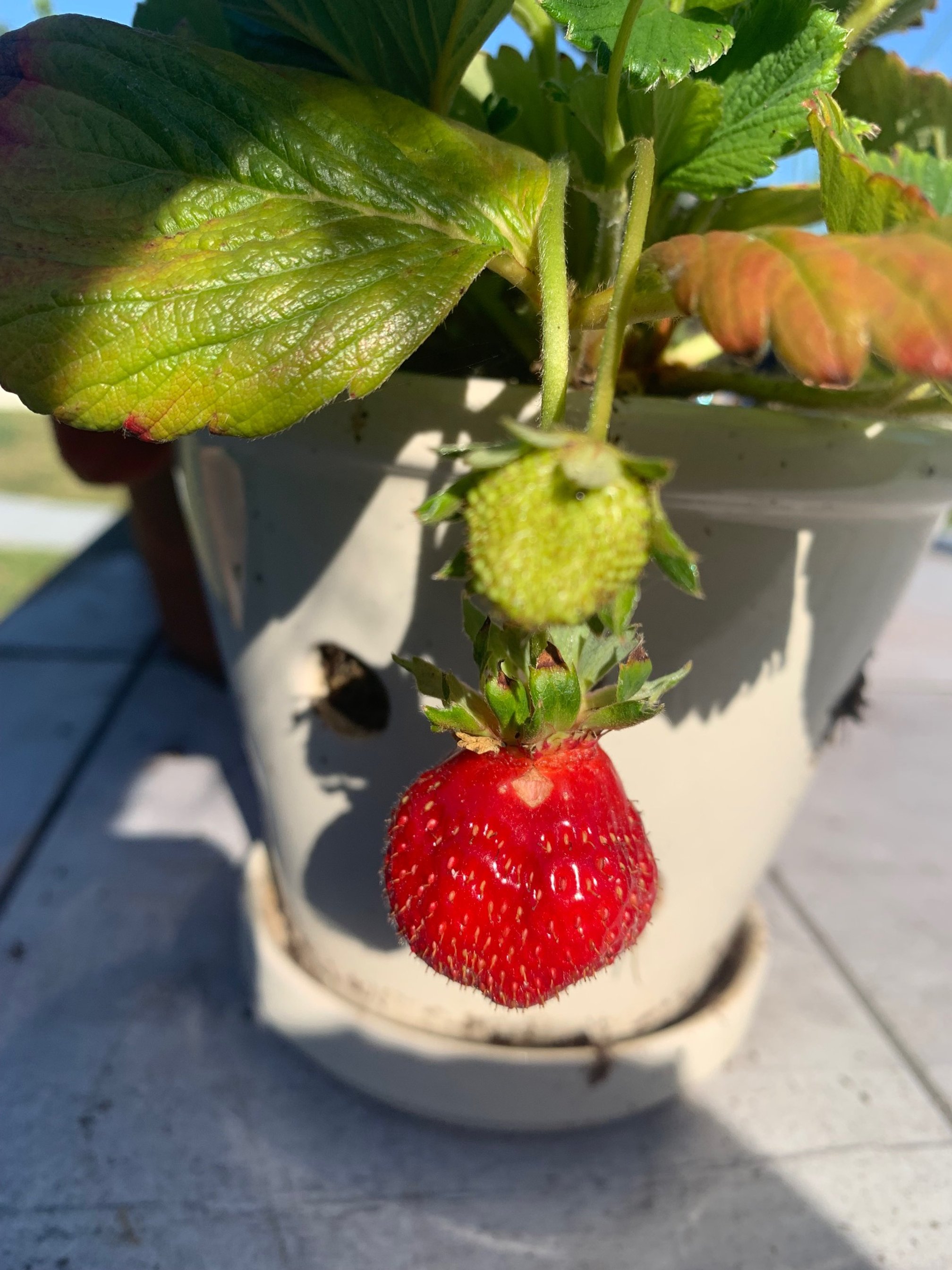
Once upon a time, there was a strawberry plant that grew out of a pacifier!

You’re probably asking yourself, 'How is that possible?'

But it's the truth.

A year ago, our granddaughter - three years old at the time - was struggling to give up the comfort of the pacifier when she went to bed at night. Our son and daughter-in-law tried everything, but the resourceful toddler was a master negotiator. She managed to get it back every time.

One day, our daughter-in-law came up with an idea that she says she found on the Internet. The story went that when a pacifier was planted in soil, strawberry plants grew up from it.

Our granddaughter LOVES gardening. She’s the child who saves the seeds of everything she eats because she wants to plant them in the garden. And she is incredibly smart, so I think this whole scenario of going along with it was actually just to humor the parents and the grandparents. Nevertheless, she painted a clay pot as an activity, then put dirt in it and planted the pacifier two inches down. Add water.

The next morning, there was no plant yet, but miraculously, a strawberry sat on top of the soil. Much excitement ensued. So the next day and the next day for the rest of their visit with us, strawberries appeared every morning!

Good thing she wasn’t up at five am. She would have caught her father running from the fridge to the pot, arranging strawberries.

Anyway, the method worked. The pacifier habit was broken.

But once the kids went home, we couldn’t let the pacifier plant go, so we repotted the pacifier and put a strawberry plant in there. When she looks closely, she'll be able to see it in one of the holes in the new pot. And what do you know, strawberries are maturing just in time for our granddaughter’s upcoming visit.

Now how about you? What kind of unusual things have you planted in your garden?

The Writers Behind Nik James

A BLOG INTERVIEW WITH DORIS MCCRAW OF WESTERN FICTIONEERS

In this interview, we meet a husband and wife team, and new Western Fictioneer members, who use the pen name Nik James. It is interesting to hear both their voices in the answers. I hope you enjoy their answers as much as I did. 

1. When did you realize you wanted to be a writer?

We’ve always been writers and readers. Nikoo used to write stories for her grade school friends. After high school, being very good at math and science, she went to engineering school. After all, that was where the jobs were. She tucked away her love of writing (in a safe spot) to pursue her immediate responsibilities. As a result, writing took a back seat to paying a mortgage and raising a family. She never lost her love of storytelling, though. 

Jim wrote ‘007’ skits for the kids in the neighborhood and poetry for himself. He later became an English major and at least tried to stay in touch with his desire to write. In fact, after finishing college he wrote a screenplay that almost sold to Robert Redford’s production company. But real life again interfered with dreams as he pursued a career in a submarine shipyard before going back to school and getting his Ph.D.

2. Did you choose the genre you write in or did it choose you?

We’ve written in a variety of genres (under a variety of pen names), and we have definitely chosen them…from medieval Scottish historicals to contemporary thrillers to Westerns. 

Twenty-five years ago, we began writing what Malcolm Gladwell refers to as ‘Northerns’—stories in which the fictional setting and story have a functioning system of justice in place. These were our early British-set historical novels. From there, we created a dozen ‘Easterns’—stories in which the system in place is corrupted by the ‘bad apple’ on the inside. These were the Jan Coffey contemporary thrillers. Continuing our literary journey, we traveled into the world of ‘Southerns’—stories in which the system itself is corrupt. This sojourn included our more recent historicals—violent, political, and also British-set. 

Now, we’ve followed our trail into the fictional world of ‘Westerns’, where there is no viable system of justice in place, no law and order…except that which the strong, independent hero can impose. It is a world where Caleb Marlowe, the protagonist of this new series, lives by a personal code that pits him against the ruthless greed and murderous ambition of landowners and railroad barons, as well as the powerful natural forces of the American frontier. We’re drawn to the chaos in which men and women must carve out a place for themselves. We feel quite at home in this literary frontier.  

3. What was the nudge that gave you faith that you could and wanted to be published?

After our younger son successfully came through heart surgery as an infant, we found ourselves reassessing our lives and our goals. We wanted careers that gave us more flexible hours to be with our family. That’s when we decided to try writing a short story together. That story, a prizewinner in a national writing contest, was the first step. The next step, naturally, was a full-length historical novel.  

4. Do your life experiences influence or hinder your writing? 

They definitely influence our writing. I (Nikoo) am an immigrant. The comfortable bubble of the life I grew up in was pierced when I left my country and came here as an eighteen-year-old. The bridge behind me collapsed. And straight ahead, there was a frontier with many challenges that I had to face. 

Aside from coming from a strong tradition of storytelling, I spent years working in cutting-edge areas of technology and business, and those experiences brought me a wealth of knowledge and discipline. As a woman in a predominantly male field, I crossed paths with some unforgettable characters…and character is really at the heart of our writing. Jim has worked in so many places, from submarine shipyards to Rodeo Drive clubs to academia. So he too has met a few characters along the way, and his love of research in historical periods has often influenced our choices of time periods and the situations in which we place our characters. 

5. Where did you get the idea for your latest release and tell a bit about the story?

We’ve always been drawn to the lone, reluctant hero, and the myth of the American West is built on that ideal. Our protagonist, Caleb Marlowe, embodies the spirit of the men and women forging a new life for themselves in the frontier. We think readers will find our Nik James novels have the historical feel of Lonesome Dove, the high-powered action of John Wick, and the heightened social awareness of 2021.

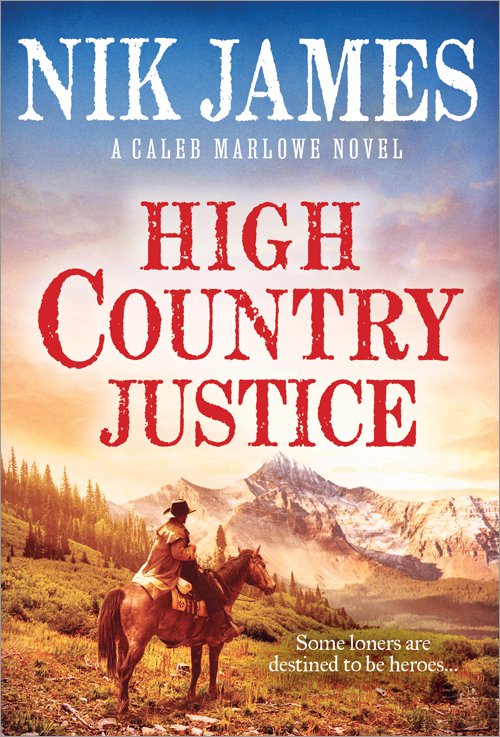
High Country Justice, the first book in the series, introduces Caleb Marlowe—mysterious, guarded, unpredictable, and famous for a lightning-quick draw and nerves of steel. He wants to leave his past behind, but the past has a way of dogging a man.

When Doc—Caleb’s only friend in town—goes missing, his daughter comes seeking his help. Newly arrived from back East, she hotly condemns the bloody frontier justice of the rifle and the six-gun. But this is the high country, and justice is fierce.

To free his friend from the murderous road agents, Marlowe will have to track them through wild, uncharted mountain territory, battling wild animals and bushwhackers. And when the daughter is captured by the ruthless gun hawks, Marlowe will have to take them down one-by-one, until no outlaw remains standing.

6. Do you plot your stories or go by the seat of your pants?

We’re plotters, but that’s pretty essential in a team effort. And we have written everything collaboratively since the day we started our first novel. But we never let our planned plot get in the way of a good story. The key is to clearly communicate possible changes with each other. 

7. Is there a writing routine you follow or do you write when the Muse strikes?

We’ve never been ‘Muse’ types. We write almost every day. When we’re not at the keyboard, we’re walking and talking about stories and craft and publishing. Nikoo is always up around five a.m., reading and planning the day’s writing and working on staying on top of the business. Jim is up around six, and we’re both at the computer between 8-9. We write until noonish, when we have our dinner, and then go back to writing until about 4 when our dog tells us he’s ready to eat and go for a walk. If we’re up against a deadline, we’re back at the keyboard until we drop.  

8. If you had a choice, which is your favorite to write, short stories, novellas, or full-length novels?

Definitely full-length novels. 

9. Do you ‘interview’ your characters before or at any time while telling their story and what do you do if they don’t cooperate with your story idea?

We’ve used the ‘interview’ technique in the past and still do it occasionally. But because we are a collaborative team, we continually talk and talk and talk about who our characters are, what they aspire to do, how their fears and flaws affect their actions, and what they’re feeling. We get to know them pretty well that way.

We are firm believers that the characters MUST drive the stories. As we said, we are plotters, but the integrity of a character’s composition must take precedence over our consideration of plot. We’ve all read books in which an author forces the protagonist to do something that is out of character for him or her, simply to keep a plot on track. We’ll never do that because it frustrates the reader’s belief in the reality of that character…and the story. If a character doesn’t cooperate, then he or she is right, and we roll with it. 

10. Is there a process where you find your next story or does the idea just hit you?

Story ideas can come from anywhere: the news, history, television, our reading, talking to friends, dreams, etc. Once we have the glimmer of an idea, we walk and talk and walk and talk and walk and talk. And then walk some more. Nikoo needs to move to think creatively. For the past twenty-five years, we’ve chosen our residences based on the proximity of a walking trail or a park.

11. Is there anything else you feel people would like to know or would be surprised to learn about you?

Two things. First, our fiction has a strange tendency of being prophetic. That has happened a number of times. One of our YA novels for Harper Collins (Jan Coffey’s Tropical Kiss) was set in Aruba and featured an American student who was abducted at one point in the novel. Just weeks after Tropical Kiss was published, an American girl named Natalie Holloway went missing. Our story turns out happier. The premise of our novel Five in a Row became the topic of a New York Times article “Can a Virus Hitch a Ride on your Car?”. The journalist even used experts we talked to in researching the novel. In our story, a cyber-terrorist is taking control of people’s cars. Now, we’re not saying Elon Musk is that guy, but those Tesla vehicles ARE self-driving.

Second, because Jim was an academic and Nikoo an engineer, people might have a preconceived notion about their personalities. So it might surprise them that Jim is ‘type-A’ when it comes to his attitude toward life. Everything he touches has to be sorted by size and type and color and texture and whatever. His desk, the garage, his clothes, the dishes, the dog’s toys, they’re all neatly organized and categorized. The bookcases would be alphabetically arranged if it wasn’t for someone else’s meddling. Even the dishwasher can only be loaded by him. Nikoo is far more relaxed, saving her energy for more important things, like writing.

13.  What are your favorite areas of research and why they are important to you?

Both of us love politics, and we’re fascinated with history. It’s important to understand the social currents of progress. We believe that human nature doesn’t change, and “Those who cannot remember the past are condemned to repeat it.” 

14.  When do you start to ‘market’ your new release?

The main channel of marketing for us is our newsletter. Some of the subscribers have been with us for over two decades. The newsletter is year-round, and we try to reach out to subscribers at least once a month. The marketing of the individual book starts at least six months ahead of release. 

15.  What advice would you give to those who dream of writing, or what advice would you give your younger self?

To those who ‘dream’ of writing, there’s that old 60s song about, “Wishing and hoping and thinking and praying, planning and dreaming…That won’t get you into his heart.” Our advice would be to start writing and keep writing. We all learn and relearn every time we sit at the computer and connect with our characters and the quests and conflicts and obstacles we throw at them. 

To our younger self, the advice would be “Brand yourself.” We’ve made the mistake of following our hearts and telling many different types of stories. The journey has been fun but the marketing a nightmare.  

16. Are there authors you grew up with or inspired you to take pen to paper?

Nikoo remembers skipping classes in middle school and hiding behind the shelves in the library to reread Victor Hugo’s Les Misérables, Hemingway’s For Whom the Bell Tolls, Tolstoy’s War and Peace, and many others. She was and is a reader. Those authors and many others inspired her. 

As a child, Jim read every historical biography he could find. As he reached high school and college, he was captivated by Fitzgerald and Hemingway, Arthur Conan Doyle and Charles Dickens, and Willa Cather. 

17. If it were possible would you choose to go forward in time or back?

We’d both definitely choose to go back in time, but who in the world would want to go back to a time before modern dentistry?

Check out the entire Western Fictioneers blog at https://westernfictioneers.blogspot.com

Anniversaries

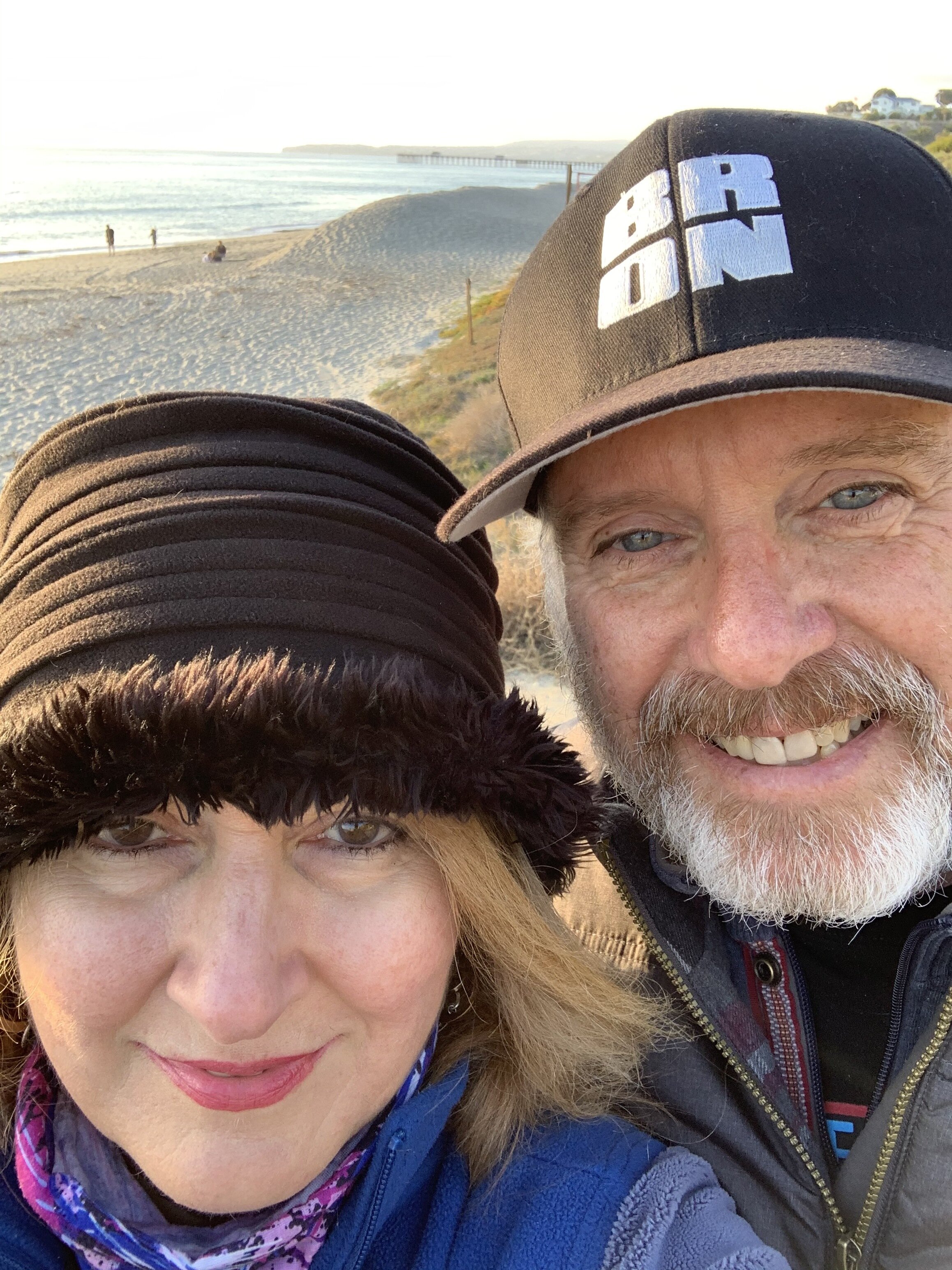
Nikoo and Jim Dana Point.jpg

This week, we’re celebrating another turn around the sun in our life of togetherness. We’re always asked by those who know us, those who meet us, those who learn what we do for living and those who know how much time we spend together each day…so what do you do on special days like your anniversary?

Being experts with our words, we generally tell people that what we do is not as important as what we say. So here is a list of some of the things one of us has said to the other on our anniversary over the years.

“Thanks for being my unpaid therapist.”

“Too late. No refunds. Happy Anniversary!”

“Your father’s check never arrived. But I’ll still keep you.”

“There’s no one else I would rather have snoring beside me.”

“It’s our anniversary. Please, no beets on the salad.”

“Happy anniversary, my love. Eat all the dark chocolates again and I will end you.”

“Happy anniversary, my love. Eat that last Milky Way, and we’re going to war.”

“I love you so much I’d take a bullet for you. Not on the chest, but maybe like…in the leg.”

“We love each other. Nothing is impossible. Except deciding where to go to eat.”

“I fall in love with you more each and every day. Except for yesterday. Yesterday, you were really annoying.”

“I really love you, hashtag, hashtag, hashtag. Can we eat now?”

“It’s our anniversary. Try not to cheat at backgammon.”

“It’s our anniversary. Let’s vacuum.”

“You’re the most handsome man in the world.”
(Response) “You’re the most beautiful woman anywhere.”
(Response)“How great that we’re losing our eyesight together.”

“It’s our anniversary. Maybe we can get a couple of chapters done before dinner?”

Do you see a pattern here? Well, it sort of goes with the territory of always being around each other.

'Fur' Better or Worse...Animals in our Lives

“And the Award for Best Dog in a Supporting Role goes to…”

marlo.jpg

Jim and I are animal lovers. Dogs mainly now, because over the years I’ve become allergic to cats. Still, all animals have a warm spot in our hearts. Except snakes. But that’s a story for another day.

Years ago, right after we settled in our first apartment, I was on the hunt to get a small dog similar to the Bichon Frise that I had as a pet growing up. Fast forward to our first Christmas Day as a married couple. Visiting Jim’s parents, we decided to stop at the dog pound in Meriden, Connecticut. As it turned out, the dog warden was there feeding the animals.  

The shelter was filled, but there was no little white dog. Well, if there was, we never got to see it. As we were walking down the aisle, the dogs were barking and howling…until we reached one cage. A large, silvery black dog weighing about a hundred pounds sat quietly watching us with the most soulful eyes. When I put my fingers through the chain link, he stood up and pressed the top of his head against my fingers. His name was Bear, we were told, and he hadn’t cut it as junkyard security. That was all it took for both me and Jim. Bear went home with us.

Bear was half-Labrador and half-Newfoundland, and he wasn’t fully grown at the time. He was truly a great dog but had separation anxiety. Eating the dashboard of my first new car. Jumping out a window eight feet off the ground. Eating a newly reupholstered chair. Unlatching sliding glass doors regularly and finding his way to the nearby grocery store while we were shopping. But he was also fond of stealing the neighbor’s groceries. He regularly brought home packages of steak and chicken. He would drop them on the porch proudly without a tooth mark on them.

He lived to be about fourteen years old, survived the heartworm he had when we got him, and grew to about a hundred and thirty pounds. Big, silvery black, and as gentle as a lamb with our firstborn.

When we wrote The Thistle and the Rose, we made him a character.

Our next dog was Max, a Golden Retriever. Our boys grew up with him. He had all of the personality that goes with the breed. As far as he was concerned, he was the center of the family’s universe. Actually, he thought he was the center of the entire universe.

And he loved our sons. When we were living in Connecticut, there was a cemetery past the woods near the house. Beyond the cemetery were the playing fields of the school our boys attended. One day, we were watching our older son playing lacrosse. Max was home with our younger son and his friends.

Suddenly, the crowd of parents were shouting at a goofy yellow dog jumping up on one of the players on the field. He was totally disrupting play. We couldn’t believe anyone would be so inconsiderate as to let their dog loose on the field. Then we realized the player was our son and the dog was Max. One of the neighborhood kids had let Max slip out of the house, and the beast had raced up through the cemetery to the playing fields and found his human. He was the highlight of the afternoon for both players and parents.

When we wrote our second Jan Coffey novel, Twice Burned, we made Max the romantic lead’s dog. He nearly stole the show there too.

It’s true that we tend to think that every dog we have is the finest animal on the planet and the best dog we’ve ever had. Our current dog, Marlo, is no exception. Eighty pounds, light tawny colored fur, a black face and deep brown eyes. And an absolute love. He doesn’t destroy things and doesn’t bring home dinner. And his favorite activity is moving from my office to Jim’s and back again. He also considers himself the schedule keeper. He can tell time and knows how to push us out of our chairs when the hour comes to feed him and take a walk.

Marlo is super friendly with other dogs and kids and neighbors. Unless you smell like a hamburger. Then he’d probably lick you to death.

He’s so special that we had to make him a character in the new series of Nik James Westerns. But we couldn’t JUST make him the protagonist’s dog. We named the hero after him. Yup. Caleb Marlowe.

Our animals are so precious to all of us. It doesn’t matter if they’re dogs, cats, canaries, goldfish, hamsters, goats, horses or whatever. So often, these creatures provide the unconditional love that gets us through the tough days.

A Rose by any Other Name

What's in a name?

Some of us were gifted with simple names at birth. Names that everyone can pronounce and spell, where there is no confusion about the meaning.

Names like…Nikoo.

Others were given more complex names. Names that inevitably start conversations like What kind of name is that? or Where are you from?

Names like…James.

Gary_Cooper_in_The_Virginian_1929.jpg

Then there are other names that we choose. Names like May McGoldrick – after Jim’s grandmother. Or Jan Coffey – an acronym for Jim and Nikoo plus Nikoo’s maiden name. Or Nik James – you guess that one. By the way, these are the names that put the food on our table, so please, friends, remember them.

So what’s the deal about names? Well, one of us can’t remember them. And the other one of us is great at faking it when it comes to remembering names.

Nikoo: I continually mix up the names of Jim and our sons and our dog and the pet ferret next door. So when I come in contact with a familiar face out in public, I do my best to NOT mention the person by name for the fear of saying, “Hi Nancy…I mean Sally…I mean Lizzie.” I really don’t want to make a mistake.

Jim: I know everyone, and I remember everyone’s name. All right, before Nikoo jumps on this, I admit I’ve made a few mistakes over the years. Like asking a person at an event, “I remember you. You were Mr. L, my high school typing teacher.” And having the person respond, “Uh, no. I’m Jack Z. I was three years behind you in high school.”

Nikoo: And there were other moments. 😉

So why all this talk about remembering names?

We’re attending our first in-person event in a long time, to raise money for a literacy group in Richardson, TX. And if you decide to join us (Buns & Roses Literacy Tea, October 2021, please know that one of us will be searching her brain desperately for your name, and the other will address you as his favorite high school teacher.

A Gardening Chat with Nikoo and Jim

turkeys.jpg

Happy April, Friends!

Well, Spring has arrived in the northern hemisphere, and the two of us here in California are all enthused about spending every free non-writing moment working on our garden.

A disclaimer! Neither of us was born with a green thumb, but we work hard. There have been years when we were famous for our five-dollar tomatoes and the half-acre of kiwi vines that never bore fruit. But there were other times when we had enough zucchini to feed the entire eastern United States. Are we exaggerating? Maybe.

We do have a thing or two to share when it comes to gardening. The most important being, talk to other gardeners and don’t be afraid to experiment.

Experiment. That brings back the memory of an Easter Sunday a couple of decades ago. At the time, we were living in Bucks County, Pennsylvania...

Jim: The neighborhood advice was that there’s nothing better than turkey manure for the garden. Our friend next door told us that the local turkey farm was giving away free bags of manure that weekend. So I went over Saturday evening and picked up few big bags of the stuff. Because we had Easter activities to prepare for, I left them sitting in the back of the SUV.

Nikoo: Our sons were always fond of our annual Easter Egg hunt. And after tucking the boys in, I always got the baskets ready and then set the eggs out on the lawn in the front and side and back yards.

Jim: When we were done, I realized that the manure was probably making the car smell pretty ‘fowl’. So before going to bed, I dragged the bags out and quickly spread the manure over the garden.

Nikoo: Easter morning. We came home from church, and the boys excitedly dove into their baskets inside the house and then ran outside to find and gather the eggs.

Jim: That’s when the shouting started.

Nikoo: As soon as I saw the garden…yikes, I can’t repeat what I said.

Jim: Turkey feet were sticking straight up out of the garden like we’d buried big birds upside down. Mixed in with the manure were feathers, legs, and unidentifiable turkey parts. In the dark, I hadn’t seen what I was spreading.

Nikoo: The commotion at our house brought the neighbors’ kids running.

Jim: The entertainment value of the “Great Turkey Massacre” far surpassed the egg hunt.

Nikoo: It was definitely one of those ‘You had to be there’ moments. The event is now firmly enshrined in local lore.

Jim: But I do have to say, that year we had our best garden ever.

Nikoo: And why are we sharing this? Because writing is so much like gardening, though much messier.

Anyway, when we start a writing project, we dig around until we find our plot. We compost with the right kind of research (Learned a lessen there!). We plant the story seed and let it germinate. We begin and write and revise.

We’re not going to belabor the metaphor, but that, in fact, is what we’re doing right now.

Nik James has three books that are being published this year. And we’re already plotting and working on Caleb Marlowe’s next set of adventures.

May McGoldrick has started to write the first novel in what we’re calling our ‘Trailblazer Series’. It features women engineers in 19th century. (Nikoo knows a thing or two about women engineers. 😊)

The first story goes something like this... He’s an industrial giant. She’s an inventor who needs his money to survive. Unfortunately, they have a history. She has a week to convince him to invest…and falling in love is not part of the plan. Think, Christmas in Connecticut and When Harry Met Sally, set in the Scottish Highlands.

Jan Coffey isn’t slacking, either. She/He has been busy working on a historical fiction novel involving two timelines. The earlier story focuses on two sisters who went to work in an American shipyard during WWII. (Another topic that we know a lot about, since we were both shipbuilding ‘yardbirds’.) The present day plot involves solving the disappearance of one of them.

Now think of this as a pick-your-own farm. You’ve got your basket. What do you think of what we're planting these days. Let us know.

The Origins of Nik James

little cowgirl.jpg

Not too many years ago, we were walking down the book aisle at Costco, and a woman had picked up one of our Jan Coffey books off the pile and was reading the back. In our excitement, we made an unforgivable mistake. We approached and told her we’re the authors and if she decided to buy the book, we could autograph it for her. She put the book down and ran all the way out of the store.

We’re often asked, “Why so many names?” and “Why can’t you write under one name…or your own names?” Well, this is a good time to share where Nik James came from and why we’re also writing Westerns.

Here’s a slice of our past:

In a fading photograph taken on an old Kodak Brownie, a little boy glares at the camera with same swagger and disdain that Clint Eastwood would direct at movie audiences over a decade later. The six-year-old, dressed in his battered cowboy hat and vest, has six-guns strapped to his hips and a cigarette between his fingers.

Halfway across the world, a little girl waits on the stoop for her father to return home. It was a tradition that they’d spend their Saturday afternoon watching John Wayne stride across the screen on the ‘American station’ that had recently joined the other two TV channels available. Later that day, while she was running through the neighboring woods with her friends, fighting off outlaws with cap guns and air rifles, her cousin would shoot her in the arm with his new .22-caliber rifle. This half of the Nik James duo still bears the scar proudly.

On both sides of the Atlantic, the two storytellers grew up watching Bonanza, Rawhide, Have Gun Will Travel, Wyatt Earp, Wagon Train, Roy Rogers, Maverick, and Sky King. It was the Wild West that captured their imaginations, as it captured imaginations everywhere.

Fast forward to a different world, a new frontier that Nikoo would face alone, far from her childhood home, training to support herself as an engineer, but never leaving behind the ‘switchblades and code of honor’ of her youth. Jim would take on the challenges of shipyard life and the classroom. But they both itched to tell the stories that prodded at them.

So here we are, twenty-five years into our publishing career, finally writing Westerns together.

Now, as Nik James sits at the keyboard, Nikoo is again that girl running through the woods with her rifle. And Jim is that boy, donning hat and vest and strapping on his twin Colts.

For Better or Worse… How We Started Writing as a Collaborative Team

NikooandJim beach.jpg

If we dropped a penny in a jar every time someone asks us, “How on earth do you manage to write together?” we’d have enough to book that next roundtrip flight to Istanbul to see our granddaughter. Sometimes, we give them the short answer, to others the long answer, and a few get the in-between answer. And we don’t really mind the question.

Then comes the next one: “How did you start?”

Our collaboration started on a snowy day on a snowy weekend during a snowy winter. We were living in Pennsylvania, and our boys were small.

Nikoo: Jim had decided to submit a short story to a national writing contest posted in Writer’s Digest magazine. He was looking for publication credits he could add to his tenure portfolio at the college where he was teaching. The story was pure adventure and featured a guy trying to save his small sailboat in the middle of Newport harbor during a hurricane. I remembered him writing it in grad school.

Jim: Nikoo has always been a brutally honest person, and she has strong opinions. That’s just two of the many things I love about her. But I can get a little defensive about my writing. She was working as an engineer, but she was always a closet writer. I, on the other hand, pursued my writing openly. And for all our years prior to that snowy winter, she was my first reader. Anyway, before sending the story off, I asked her to read it again.

Nikoo: So I read it. Now honestly, who cares about a guy trying to save a catboat while scores of people are losing their homes and… I don’t remember what I said exactly.

Jim: She said, “Don’t bother.” Maybe she worded it in a gentler way, but that was the bottom line.

Nikoo: He turns around and asks me, “Could you do better?”

Jim: And she says, “WE could do better.”

An entire snowy weekend passed while the two of us sat side-by-side and a new story emerged.

The ‘man saves his catboat’ story turned into ‘a woman contemplating suicide boards her catboat in the middle of a hurricane’. Her past plays itself out in the course of battling this storm. Old and painful conflict with her father. Guilt that haunts her about the death of her brother. Failed relationships.

We both physically wrote portions of that story and contributed when we weren’t actually pounding the keyboard. Agreements and disagreements. Pizza. Kids swinging from the chandeliers in the background.

We loved it.

We sent the story off, knowing we’d done something special. That short story went on to win a national prize. But by the time we heard the results, we’d already started a novel. It was our first, The Thistle and the Rose. The first of many.


Subscribing to our newsletter will provide occasional insights into the meandering nature of our minds. Sign up here.

Fresh Fiction...and Scones!

The wonderful folks at FreshFiction were kind enough to have us in for their Valentine’s Deay Recipe Roundup. Here’s our contribution. Be sure to visit them for great news and events and information about your favorite authors and books! Here’s the post…and the recipe!

We're pleased to present another delicious recipe on our Valentine's Day Recipe Roundup from the historical romance writing team, May McGoldrick! 

In Highland Sword, Aidan Grant and Morrigan Drummond are both proud and principled. He is a barrister. She is a trained fighter in search of revenge. They each know their own mind and are certain about what they want. And they end up spending a lot of time together, be it fighting in Inverness alleyways or the training yard at Dalmigavie Castle or duel each other in a battle of wits. But it is during the night of the Samhain celebration that their romance blooms.

Many of our readers already know that May McGoldrick is actually two people – Nikoo and Jim McGoldrick. We write together, live together, love endlessly, and enjoy cooking together. In our household, Nikoo loves the everyday and holiday cooking, and Jim is great at baking.

In this Highland competition, players are banned from using their hands. This game challenges participants to take bites out of treacle scones dangling from string. How can you lose?!

Ingredients:

1 3/4 cups all-purpose flour

4 teaspoons baking powder

1/4 cup white sugar

1/8 teaspoon salt

5 tablespoons unsalted butter

1/2 cup dried currants or raisins (optional)

1/2 cup milk

1/4 cup sour cream

1 egg

1 tsp ground ginger

1 tsp all spice

1 tbsp treacle (molasses)

Directions:

Preheat the oven to 400 degrees F (200 degrees C).

Sift the flour, baking powder, salt and spices into a large bowl.

Gently heat the butter with the sugar and treacle and stir till sugar has dissolved completely

Let this cool a little before adding the egg and milk and sour cream (save a little to glaze the scones before baking) then stir gently in the dry mix until well blended. Add the raisins and currants, if desired.

With floured hands, pat scone dough into balls 2 to 3 inches across. Let the scones barely touch each other. Brush the tops of the scones with the egg and milk leftover. Let them rest for about 10 minutes.

Bake for 10 to 15 minutes in the preheated oven, until the tops are golden brown. Hang them from the strings, and have fun chasing the deliciousness at any time of year.

Publisher's Weekly Article - Blame Jane: Romance Novels 2019–2020

We were delighted to be included in “Blame Jane: Romance Novels 2019–2020: What’s so great about Regency romances anyway?”, a wonderful Publisher’s Weekly article about the ‘new’ Regency romances that are being published, novels that are changing the way we, as readers and writers, see the stories, the characters, and the history of the period itself.

PW article.jpg

The article by Betsy O’Donovan, a journalism professor at Western Washington University, includes discussion and quotes from such great authors as Anna Harrington, Jo Goodman, Vanessa Riley, Christina Courtenay, Evie Dunmore, and Betina Krahn. Fair Use guidelines preclude us from republishing the article here, but we thought we’d include a few of lines of our input to entice you into going and reading the entire piece.

Excerpted from

Blame Jane: Romance Novels 2019–2020

What’s so great about Regency romances anyway?

by Betsy O’Donovan, Publisher’s Weekly, 11 November 2019

Defending the Crown

“Readers are infatuated with the Regency; let’s give them something more,” says Nikoo McGoldrick, the storytelling half of the married duo behind the pseudonym May McGoldrick (Highland Sword, St. Martin’s, Mar. 2020). “As writers, you take a popular period like Regency, lure the readers in, and then do what Charles Dickens did: you show them life.”

[….]

Rethinking What’s Regency

Jim and Nikoo McGoldrick believe there’s much more to say about the dramatic events that shaped the Regency era. These issues may have been discussed at Almack’s and other social clubs, but they’ve generally been avoided in the genre.

“You have revolutionary forces at work and colonialism is running rampant, and it’s driving governmental actions,” Jim McGoldrick says. “People are fighting in the streets. The industrial revolution is in full gear. Rape and pillage is the order of the day.”

Though ballrooms provide a glittering backdrop, many Regency authors are acknowledging that the people dancing there were ruled by a mad king and a licentious prince, were confronting a politically active middle class that vehemently opposed the concentration of wealth and privilege, and were just beginning to see the cracks in their empire.

“In our Regency,” McGoldrick says of this new wave of romances, “we love Jane Austen, but Pemberly is in danger of being burned to the ground.”

 Read the entire article at Publisher’s Weekly.

Interview with Romance Junkies

Welcome to Romance Junkies, Nikoo and Jim McGoldrick! As a fan of your May McGoldrick Royal Highlander series, I’m thrilled to introduce you to our readers.

May: Thank you so much for this opportunity. And we’re so thankful for all the support for our stories that you’ve sent our way over the years.  

Romance Junkies: First, can you tell us about your current release and any upcoming projects a Romance Junkie will be interested in?

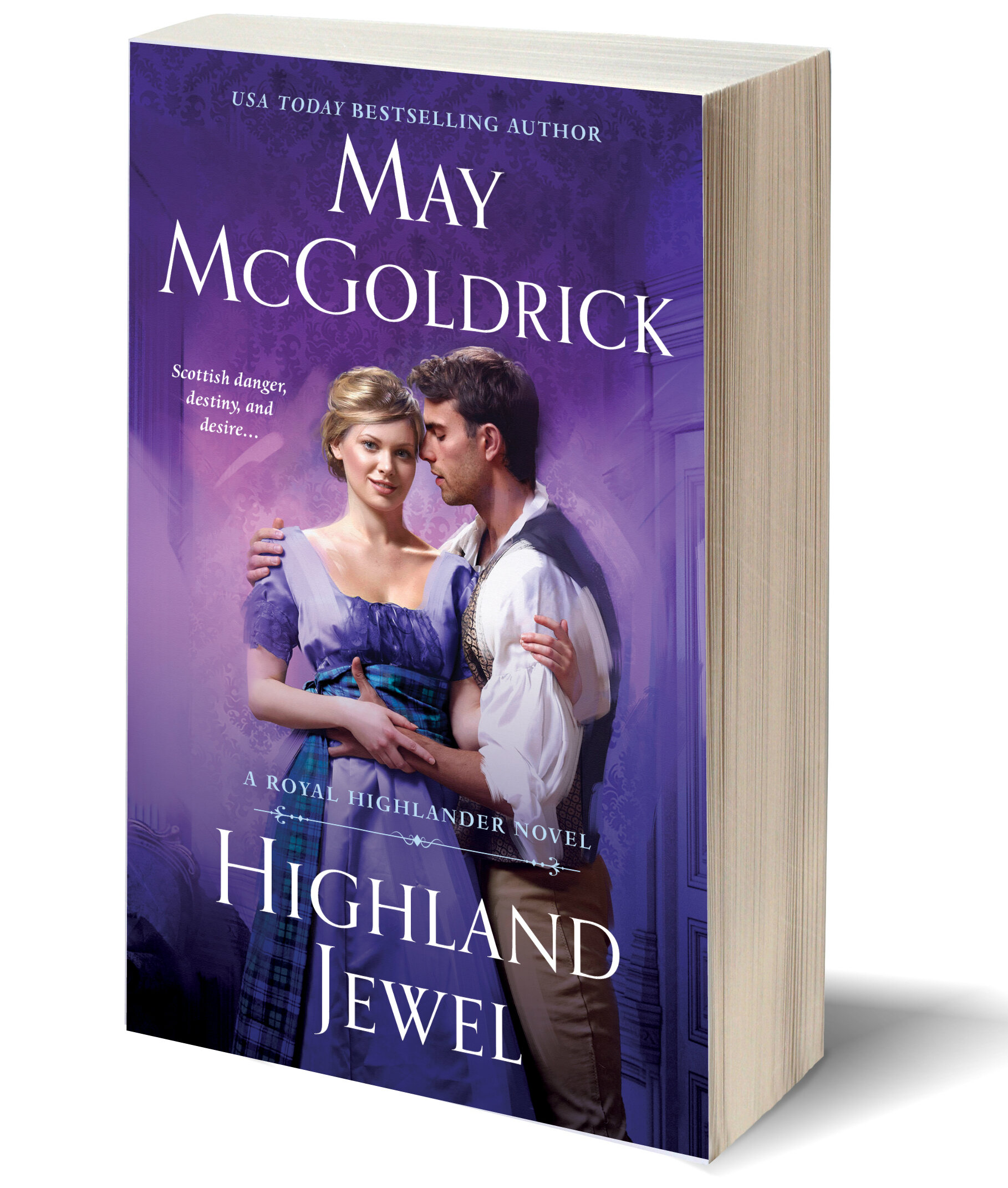
May: Highland Jewel, our second book in the Royal Highlander Series, is a September 24th release. And the next, Highland Sword, is scheduled for publication March 31, 2020.

In Highland Jewel, The Radical War of 1820 has extended into the Highlands. Maisie Murray and her family have found shelter at Dalmigavie Castle, the heart of the rising in the north. The dangers of their past have followed them, but they are committed to Scotland’s fight for freedom. A messenger brings the promise of an important ally to their cause, but only Maisie recognizes that falsehood and betrayal have also arrived at their door.

Six months earlier, Maisie was the picture of docility, quiet and compliant in the eyes of her family. To her activist friends, however, she was a fearless crusader for women’s rights. In the wake of the Peterloo Massacre, Maisie and a friend founded the Edinburgh Female Reform Society, and she carried the banner for universal suffrage. Caught up in the wave of her enthusiasm, Maisie never expected to fall in love with the brother of her friend and fellow reformer, the man who saved her life during one of their protests.

Niall Campbell, a hero of the wars and a decorated officer of the Royal Highland Regiment, is battle weary and searching for stability in his life. A fierce warrior by training and a poet at heart, Niall walks away from the shining career that lies ahead of him, to the dismay of his superiors.

Niall is frustrated by his inability to curtail his sister’s involvement in the women’s reform movement. A widow with two children, she is determined to ignore the dangers of her radical positions. In saving his sister when a protest turns violent, he meets Maisie. Their relationship begins as one of experience versus idealism, of scars versus hope. Soon, however, he finds in Maisie the heart he longs for.

When Niall’s sister is arrested and disappears, he quickly realizes his life is not his own, for the British authorities have a mission for him to accomplish in exchange for his sister’s freedom.

Overnight, Maisie loses Niall, her friend, and her home. In the wake of the riots that sweep through the cities of Scotland, her own sister Isabella is branded a traitor to the Crown, and the family must flee to the Highlands. They take shelter at Dalmigavie Castle, under the protection of the charismatic Cinaed Mackintosh.

Here in the heart of the Highlands, Maisie runs into Niall again. He carries a message of hope…but has a terrible task to complete.

Maisie and Niall’s future rests on their ability to overcome the forces that divide them, or—for the future of Scotland—she must stop the man who owns her heart.

Highland Sword is the conclusion to the Royal Highlander series. In this novel the reader meets Morrigan Drummond.

Independent and fiery, Morrigan lost everything when her father was killed while caring for Scots wounded by English dragoons during a day of protests in Edinburgh. After fleeing to the Highlands, she discovered her gift. Training with Mackintosh fighters at Dalmigavie Castle, Morrigan can now shoot a pistol and handle a dagger better than any man. She is ready to use her deadly skills on the enemies of her nation. And she wants revenge on Sir Rupert Burney, the English spymaster who ordered the attack on peaceful people and the death of her father.

Aidan Grant is a Highland lawyer, at odds with the Crown for his fearless stands against the government on issues of representation, slavery, and the violent Highland Clearances. Quick-witted and popular with the Scottish people, he is a nemesis in the eyes of the repressive Crown forces seeking to crush reform across the land.

These two meet, and the battle of wills begins. She wants war; he wants peace. She is after revenge; he is after justice. She is ready to spill blood; he believes too much has already been shed. Neither one will surrender their ideals, but neither can ignore their attraction for the other.

Highland Sword is an emotional ride, but we feel reasonably confident everyone will be satisfied with how everything wraps up at the end. That being said, there is still one more very cool historical event connected to our series that may just need to be explored in another book. We’ll see.

In between writing the historical, we’re also writing a contemporary suspense novel. Stay tuned for more about that one.

RJ: I just have to know how you write together so seamlessly. Do you each write a character's point-of-view, then combine them? Does one research while the other writes? How do you split the efforts to get to the final product?

May: We both write everything. We’ve tried many methods over our twenty-five year career. But each book has its own life to consider. As you know, Jim has a PhD and I’m an engineer, but that doesn’t stop either of us from delving into the other’s areas of expertise. It’s the same when we’re writing a historical or a contemporary suspense thriller under our Jan Coffey name. We wear many hats and do it all.

Also, we each have our own writing space and habits. We still occasionally sit side-by-side as we try to wrestle a difficult plot point to the ground, but we mostly work separately on whatever scene is next. Then we swap and revise each other’s work. It takes about three times longer, but we both have to be happy with it before we move on. As far as brainstorming plots and characters, we walk and talk and walk and talk and walk and talk. And then walk some more. One of us (Nikoo) needs to move to think creatively.

Years ago Heinemann Publishers asked us to write a book about our process. Marriage of Minds: Collaborative Fiction Writing explains some of our evolving process, as well as how a dozen other writing teams manage it and remain friends (with some casualties mixed in, unfortunately).

RJ: Maisie and Niall are strong characters. Did you base them on real people, or did they come to life on their own?

May: Maisie was modeled after a reform activist named Mary Fildes, who was on the speakers’ platform at the ‘Peterloo Massacre’ in Manchester, England, a few months before our story starts. In real life, she was actually run through by a sabre wielded by a soldier who was part of the militia who attacked the peaceful, unarmed citizens who had gathered to protest the government’s actions. Mary survived and went on to lead the movement for women’s suffrage until her death decades later.

Niall’s character is based on many Scottish officers who were useful to the British Empire during the years of the Napoleonic War and after. Many never returned to the Highlands because the Crown was afraid of allowing them back in Scotland at a time when discontent and the threat of rebellion was on the rise.

RJ: I found Maisie's political involvement fascinating, which made her an unusual heroine in my reading experience. Do either of you have political knowledge that helped form her passion for it?

May: Yes. Yes. Both of us love politics, and we’re fascinated with history. We believe that human nature doesn’t change, and we also believe there’s so much to learn from the past. It goes with that old saying, “Those who cannot remember the past are condemned to repeat it.”

RJ: When you’re envisioning a series, do you plot it in advance, or let the first book determine future books as you’re writing?

May: We plot heavily because it is the two of us working together. Even though we like to brag that each of us reads the other’s mind, that goes only so far. Also, plotting is another carryover from writing so many suspense novels.

RJ: Do you see your spouse’s qualities in your characters? Do either of you see yourself in them? Does anyone else influence your characters?

May: Actual history heavily influences us. But also, we have a good understanding of what we’re about, what our core beliefs are, and what the message is that we want to infuse into our novels. After nearly fifty books, we recognize that we have consistent themes. So yes, we definitely see parts of each of us in every novel we write.  

RJ: What do you hope readers will find when they settle in with one of your books?

May: Entertainment. Memorable characters. People who you’d like to become friends with and follow through their lives. Snippets of history to engage your mind.    

RJ: What is the funniest or strangest thing that has happened to you while researching a book?

May: Our fiction have a strange tendency of being prophetic. That has happened a number of times with our Jan Coffey novels, in particular.

One of our YA novels for Harper Collins (Jan Coffey’s Tropical Kiss) was set in Aruba and featured an American student who was abducted at one point in the novel. Not long after Tropical Kiss was published, an American girl named Natalie Holloway went missing. Our story turns out happier.

The premise of our Jan Coffey novel Five in a Row became the topic of a New York Times article “Can a Virus Hitch a Ride on your Car?”. The journalist even used experts we talked to in researching the novel. In our story, a cyber-terrorist is taking control of people’s cars. Now, we’re not saying Elon Musk is that guy, but those Tesla vehicles ARE self-driving!

We can go on and describe a dozen other instances. Very strange, indeed.

RJ: If I came to your house and went through all your closets, what would I find that would surprise me?

May: Nikoo’s closet is in complete disarray while Jim’s clothes are neatly sorted by type and color and texture and whatever. 😊  And that includes our desks and everything Jim gets his hands on in the house, from the garage to the drawers (his drawers) to the dishes to the dog’s toys, all neatly organized and categorized…and it’s all alphabetical, if he can manage it. Even the dishwasher can only be loaded by him. So I let him. 😉

RJ: You've decided to throw a dinner party.  What will you serve and will it be an intimate affair or a wild one that the neighbors will be talking about next year?

May: Our house is a gathering place for friends all the time. And the parties are lively and frequent and a lot of fun. We like to cook so the menu is always changing, and we have lots of fun with it. We have to admit that Southern California weather is MADE for outdoor grilling!

RJ: What animal best describes the personality of May McGoldrick and why?

May: Nikoo’s spirit animal is the snake. I often play the role of a guide and emotional healer. The spirit of the snake represents positive, spiritual transformation. I am the sought-out friend when advice is needed. The snake facilitates life events to go smoothly – a connector of dots who reveals the big picture.

Jim’s spirit animal is the whale. Jim has a strong inner voice, and always follows his own truth. Because he’s so in touch with reality, he’s self-aware and doesn’t get involved in drama. He has strong bonds and emotional ties with those he loves.

Interviewing Each Other (for FreshFiction)

We’re very, very happy that FreshFiction has invited us to interview each other.

We’re Nikoo and Jim McGoldrick, and you might know us by our writing names, May McGoldrick and Jan Coffey.

After forty years of marriage, twenty-five years of writing together, and fifty books, we’ve had plenty of opportunities to answer interviewers’ questions—and we even wrote a how-to book on collaboration—but to get personal like this is something totally different. In this interview, we hope to take you behind the closed doors and give you a glimpse of our relationship…because that’s the magic that makes the journey possible.

Nikoo: Let’s start easy. Coffee or tea?

Jim: Too simple…and not too magical. Coffee and cappuccino in the morning, tea in the afternoon. And that’s the same with you, too.

Nikoo: What movie or series have we watched more than ten times?

Jim: Love, Actually. Casablanca. Pride and Prejudice (the BBC series). Persuasion. Jane Eyre (every version). Little Dorrit. The Guard. Waking Ned Devine. Notting Hill. Emma. It Happened One Night

Jim: What’s our go-to movie every Christmas?

Nikoo: Love, Actually.

Jim: Do you remember how we met?

Nikoo: How can I forget? I was walking along the beach in Stonington, Connecticut. In the distance I spotted you trying to shove an old wooden boat off the beach. I rolled my sleeves and walked over and threw the boat over my shoulder and carried it to the parking lot. Our first meeting.

Jim: Of course, that’s a lie. Years ago, we were invited as guests on the Jane Pauley Show. That’s when I announced on national TV that that you were a mail-order bride that I got through PersianWife.com.

Nikoo: You did do that, liar. But there was no Internet when we first met, so thankfully most of the audience got the joke and laughed. This brings us to a good question. What do we usually argue about?

Jim: The location of staircase in a castle that burned to the ground back in the 1700s.

Nikoo: That was a doozy, but we also argue about names and their spellings. Jim likes to use good old-fashioned names for our characters. Names like Thomas, George, Lawrence, Mary—which, by the way, are the names of his siblings. He couldn’t have handled it if his parents named him Nikoo as a child. I, on the other hand, love the challenge of people asking, “How do you pronounce Cinaed?” Cinaed is the hero of Highland Crown, and he comes back again in Highland Jewel and Highland Sword

Jim: My turn…what’s the best gift I ever gave you?

Nikoo: I’ll never forget it. A Vespa. A large, beautiful, red two-person Vespa. I had to get a motorcycle license to drive it.

Jim: Now that’s a story to share… Nikoo broke land-speed records driving around and weaving through the cones in the parking lot of the DMV. The trooper’s mouth hung open when she came skidding to a stop exactly where she needed to. It was a thing of beauty.

Nikoo: I have to talk about weddings. Not about our wedding (singular) but our weddings (plural). A sweet tradition at weddings now is to ask all the married couples to come to the dance floor and then the DJ does a countdown, eliminating couples by the number of years married. Well, in recent years and on a few occasions, we’ve been the last couple standing, the longest married couple. And they always ask us to give a word of advice to the newlyweds. I really don’t believe there are any shortcuts or sure-fire, winning strategies for a great marriage. You can’t condense a lifetime of work into one sentence, but…

Jim: Respect your partner.

Nikoo: So true. That’s most important.

Jim: All relationships have their ups and downs, good and bad days, pleasures and frustrations. And it’s easy to be generous when life is going smoothly. But when we’re upset, it’s easy to lay the blame on your partner, to abuse them emotionally and verbally. This extends to public ridicule, too—disrespecting each other, no matter how innocent or humorously intended.

Nikoo: Among our family and friends, Jim is known as ‘perfect’, and I am ‘flawless.’ Mission accomplished…even if the sound of gagging follows us around. We love it.

Jim: But that’s not all of it. We’re individuals. Some of us have high self-esteem, some don’t. It’s our job to be a bright mirror for our partner, reflecting all the beauty and talent that we see in them. But to do this, we have to talk to each other. And I’m not talking about talking story or plot, but asking about the person’s feelings, and also voicing what might be bothering us. Cappuccino time, or tea-time, or glass of wine time are perfect for this.

Nikoo: So true, especially since we collaborate. It’s so important to know why all of a sudden, one of us is feeling insecure after a certain event or a comment that struck us the wrong way. We’re both good listeners. We ask questions to clarify things.

Jim: Talking about everything, if there are arguments that follow. It's okay to be passionate in a disagreement, but we never sleep on it. We never sleep on an unsettled disagreement. Unresolved arguments grow roots and branches, and the fruit is poison.

Nikoo: My grandmother used to say the person who wants a rose must respect the thorn. The notion of changing our partner into the person we want them to be has never worked for us. Change must come from within. Of course, we’re both probably too stubborn to be changed by someone else, anyway.

Jim: Do I have any flaws?

Nikoo: Jim has to check the traffic report before going to the convenience store a block away.

Jim: Nikoo spreads her clothes on the chair, on top of the dressers, anywhere there is an inch of space.

Nikoo: And Jim has everything in the house, from the closets (his closet) to the dishes, to the dog’s toys, neatly organized and categorized by size, color, texture…and he’s anal about it.

Jim: And…and…she takes her seatbelt off as soon as we turn onto our street, which starts the car beeping immediately. And the first time we painted the outside of our house, Nikoo painted right over the caterpillars. But who wants to live with someone who is absolutely perfect, anyway? Or flawless?

Nikoo: Despite all this complaining, we love spending time together. Before we started writing together, there was rowing, quilting, baseball, golf, chess, tennis, skiing, backgammon, restoring an old sailboat (the one I carried on my back up from the beach), and renovating houses.

Jim: And there’s a dark side to this. I burned the chess game in the fireplace because Nikoo was winning all the time.

Nikoo: And when we play golf, I get hungry after the third hole and keep complaining about it. And I learned to row on the Charles River in Boston when I was four months pregnant with our firstborn…because that was when (and apparently the only time) they were offering lessons. And Jim’s quilting stitches are much better than mine, but I won’t admit it.

Jim: We’re both die-hard Red Sox fans—this is NOT a flaw—but in 1986 we ate chicken on every game day (because their third-baseman Wade Boggs was superstitious about it), and we used our October mortgage payment to buy playoff tickets at Fenway Park. Incidentally, we’re happy to say that this past decade has been much kinder to us (not with regard to the mortgage payments, but as Sox fans).

Nikoo: We are not just friends. We believe our friendship is the foundation of our marriage, but there’s more. Physical contact, intimacy, passion are also key parts of it. It’s important to cultivate romance.

Romance also means dating (married people need it, too), but dating doesn’t have to have a large price tag associated with it. An afternoon hike. An ice-cream cone. A drive to the beach. Okay, Jim even thinks our weekly trip to Costco is romantic. 😊  But we have fun with that, too.

Jim: When was the last time I laughed so hard that I cried?

Nikoo: Rats, rats, rats. Yesterday, when we were talking about a character not believing another character, I used the example of if I said there were rats in our attic. There aren’t, by the way, but Jim would rather not believe it, anyway. Whatever…the way it came out got us both laughing so hard we were crying.

Nikoo: Here’s a question for you. What would constitute a perfect day for you?

Jim: Every day with you is perfect.

Nikoo: Stop. Do you hear that? That is the sound of a thousand laptops slamming shut. 

Jim: I’m pretty sure I heard an ‘awww’ out there somewhere…before the slams.


Q & A with Keira Soleore of Frolic

Q&A for Frolic

 Keira Soleore: Welcome to Frolic! It is wonderful to have a chance for a quick chat with you about your two newest books in the Royal Highlander series.

 May McGoldrick: Thank you so much, Keira, for this opportunity. We’re a big fan of Frolic Media and of you personally, since (like you) we’re both engineer (Nikoo) and medievalist (Jim). We’re, like, clones!

 Keira: Before we get to the books, Nikoo and Jim, readers have been curious how your writing partnership came about. How do you brainstorm characters and plots? How do you divide up who writes what?

 May: To answer these questions, we’ll have to set up a week-long conference, a writing and/or relationship retreat (which would actually be really fun!). What we’ve been able to accomplish (40 years together, 25 years of writing/publishing, 50 books) involves a long, long, long and complicated journey. One thing we can tell you, we were both hesitant to start down that road, as neither of us had any idea about the rules. But we knew we had a lot at stake. To give you a short glimpse of that time twenty-five years ago, Jim was a college professor teaching Chaucer and Shakespeare and other things, and Nikoo was an engineer in a Fortune 500 company. And on top of that, we had a marriage and two small children who demanded every hour of our non-work hours. 

The trigger to do it, however, was our love of writing and reading, as well as Nikoo’s desire to stop working 60+ hours a week away from the family. We both had always wanted to be writers, and we’d tried individually but hadn’t succeeded, financially anyway. So, sitting side-by-side one winter night, we drafted a short story for a magazine contest.

 Our combined talent, hard work, and luck paid off. The universe aligned itself for us. That short story was followed by the idea of a novel based on Jim’s PhD dissertation. In less than a week, we had an agent. In six months, a multi-book contract with Penguin.

How we work together and why it works was a mystery to us until Heinemann Publishers asked us to write a book about it a decade later. Marriage of Minds: Collaborative Fiction Writing, explains some of our changing process, as well as how a dozen other writing teams manage it and remain friends (with some casualties mixed in). In our case, we’ve remained happily married.

We still occasionally sit side-by-side as we try to wrestle a difficult plot point to the ground,  but we mostly work separately on whatever scene is next. Then we swap and revise each other’s work. It takes about three times longer, but we both have to be happy with it before we move on. As far as brainstorming plots and characters, we walk and talk and walk and talk and walk and talk. And then walk some more. One of us (Nikoo) needs to move to think creatively.

 Keira: You have now written many books together as May McGoldrick and Jan Coffey. What was your impetus behind the Royal Highlander series? How was your writing partnership part of the story behind the series?

 May: We’re both fascinated with history. We believe that human nature doesn’t change, and we also believe there’s so much to learn from the past. It goes with that old saying, “Those who cannot remember the past are condemned to repeat it.” When we were researching and writing Romancing the Scot, the first book in our Pennington Family Series, we came across references to the fears that the aristocrats in England had about losing power. After the Napoleonic Wars were over, people wanted a fair wage and a say in government. Parliament and the Crown would not allow it, but those same leaders were afraid that all those highly trained, discontented soldiers would rise up, a revolution would take place, and aristocrats’ blood would flow in the streets, as it had done in France just a few decades before. So the British government enacted law after law aimed at crushing and silencing all opposition. They took away the civil rights of the people in the name of ‘security’ and ‘the national interest’. What followed was the Radical War of 1820, and the events are eerily similar to things happening today. Pretty scary stuff, and we thought the turmoil of 1820 would be an awesome moment for our heroines and heroes to find themselves and each other.

 Keira: In your own words, could you tell the readers about Highland Crown and Highland Jewel?

  May:  Isabella Drummond is the protagonist in Highland Crown. She is a physician who was educated in Germany. Her ‘marriage of convenience’ husband had been one of the radical reformers in Edinburgh before he was killed. So at the beginning of the story, Isabella has escaped into the Highlands with her younger sister and the daughter of her late husband. They are being hunted by English soldiers and Scottish rebels alike. 

When a shipwreck occurs off the northern coast, Isabella saves the life of Cinaed Mackintosh, a fierce soul who is aiding the clans’ continuing resistance to English domination. Sparks fly between them, but Cinaed harbors dangerous secrets, as well.   

In Highland Jewel, The Radical War of 1820 has extended into the Highlands. Maisie Murray and her family have found shelter at Dalmigavie Castle, the heart of the rising in the north. The dangers of their past have followed them, but they are committed to Scotland’s fight for freedom. A messenger brings the promise of an important ally to their cause, but only Maisie recognizes that falsehood and betrayal has also arrived at their door.

Six months earlier, Maisie was the picture of docility, quiet and compliant in the eyes of her family. To her activist friends, however, she was a fearless crusader for women’s rights. In the wake of the Peterloo Massacre, Maisie and a friend founded the Edinburgh Female Reform Society, and she carried the banner for universal suffrage. Caught up in the wave of her enthusiasm, Maisie never expected to fall in love with the man who saved her life during one of their protests, the brother of her friend and fellow reformer.

Niall Campbell, a hero of the wars and a decorated officer of the Royal Highland Regiment, is battle weary and searching for stability in his life. A fierce warrior by training and a poet at heart, Niall walks away from the shining career that lies ahead of him, to the dismay of his superiors.

Niall is frustrated by his inability to curtail his sister’s involvement in the women’s reform movement. A widow with two children, she is determined to ignore the dangers of her radical positions. In saving his sister when a protest turns violent, he meets Maisie. Their relationship begins as one of experience versus idealism, of scars versus hope. Soon, however, he finds in Maisie the heart he longs for.

When Niall’s sister is arrested and disappears, he quickly realizes his life is not his own, for the British authorities have a mission for him to accomplish in exchange for his sister’s freedom.

Overnight, Maisie loses Niall, her friend, and her home. In the wake of the riots that sweep through the cities of Scotland, her own sister Isabella is branded a traitor to the Crown, and the family must flee to the Highlands. They take shelter at Dalmigavie Castle, under the protection of the charismatic Cinaed Mackintosh.

Here in the heart of the Highlands, Maisie runs into Niall again. He has a new name and carries a message of hope. But Niall has a task to complete.

Maisie and Niall’s future rests on their ability to overcome the forces that divide them, or—for the future of Scotland—she must stop the man who owns her heart.

Keira: In both your stories, your protagonists meet in highly charged situations when the plot is fully in motion and the stories continue moving fast from there. Is this your usual storytelling style or is this how the series is playing out?

May: We love throwing our readers into the middle of action. We might have developed this style by writing thrillers and suspense. Carrying it into historical novels came naturally.

Keira: Your heroines are courageous, enterprising, passionate women. Isabella is a doctor and Maisie fights for women's suffrage. What led you to choosing these professions for your protagonists? What was your inspiration behind them?

May: These two characters were really modeled in some ways by real women from history, and then we threw obstacles in their way that were almost impossible to overcome. Dorothea Erxleben was our inspiration for Isabella. She was a university-trained physician who lived in Germany about seventy years before our story takes place. Maisie was modeled after a reform activist named Mary Fildes, who was on the speakers’ platform at the ‘Peterloo Massacre’ in Manchester, England, a few months before our story starts. In real life, she was actually run through by a sabre wielded by a soldier who was part of the militia who attacked the peaceful, unarmed citizens who had gathered to protest the government’s actions. Mary survived and went on to lead the movement for women’s suffrage until her death decades later.

Keira: When readers think of the Regency, they think of pretty gowns and balls, not the rawness of these stories. On some level, these lives and the events that unfold have a distinct medieval feel to them. Was Scotland that far different from England in those times?

May: We’re glad you mention that. If readers are looking for pretty gowns and polite courting rituals, our stories might not be for them. We have real people engaged in real struggles of life and death. Our characters, in these novels, find love that is deep and lasting, but it’s not love that is based on a clever bon mot or a shapely leg. As far as Scotland being different from England, we believe that many widely held views of history are skewed and inaccurate. Most of us have a perception of the time period that is based on what we’ve read in novels or seen in films. And many of those stories have been colored by the way some people in our society want to see the world. The reality of the Regency period—in Scotland and in England—has a great deal in common with our own era. It was a period of change and struggle and exploitation—the Radical War of 1820 took place in England and Scotland during the Regency Period. But, like the 21st century, it was also a time of romance and family and philosophy and science and, well, fashion.

Keira: I was pleased to see Niall address how the British Empire was for the financial benefit of the nobility and wealthy financiers (and the government higher-ups). Having him show what the East India Company did in Asia felt like not only had you done your research but also understood the ethos behind their actions. What made you choose this as a reason for Niall's change of allegiance?

May: In Highland Jewel, Niall has seen first-hand the way the British military were being used to promote business interests, such as those of the East India Company. Niall is a war-scarred veteran of the Napoleonic War, and he realizes that Scottish regiments are now being shipped out to Ireland and India and Australia and New Zealand and South Africa to conquer lands for a growing empire that would be exploited for their natural resources. But he also sees that the policy is being used to keep trained Scottish soldiers out of their homeland. In the Highlands, poor farm families were being violently evicted, workers in the growing industrialized cities are being exploited, and the middle class is being denied a voice in government. Deep down, Niall wants life in Scotland to be better, and joining the opposition is the only way to create change. Luckily, he meets Maisie, and that makes his journey all the more exciting and, ultimately, satisfying.

Keira: The mystery of Cinaed's past is superbly done, and I liked how it spans the two books. Are there story threads that were started in the first book that were then continued in the second? Do you have seeds planted in the first book that will then grow across the entire series?

May: Thanks, Cinaed and Isabella’s story is just too big to fit into one book. As we hinted at earlier, this is the Royal Highlander series. We’ll see more of Cinaed’s mother (who was scorned and nearly erased from history by the Prince Regent and his minions), as well as more of the efforts of the British Crown to crush Cinaed and the Scottish resistance. And we’ve got a lot more romance and adventure in store for all of our characters.

Keira: How many books have you planned for the Royal Highlander series? Whose story is next? Would you please share a teaser with Frolic's readers?

May: Right now, we’re planning on finishing up after three books, but you never can tell. Here is a little more about the story than readers will read on the back cover of Highland Sword, the third book in the series:

Three extraordinary women escaped to the Highlands of Scotland at a tumultuous moment in time. Hunted by the British authorities, each of them had to find her identity and her place in history. In this conclusion to the Royal Highlander series, the reader meets Morrigan Drummond.

Independent and fiery, Morrigan lost everything when her father was killed while caring for Scots wounded by English dragoons during a day of protests in Edinburgh. After fleeing to the Highlands, she discovered her gift. Training with Mackintosh fighters at Dalmigavie Castle, Morrigan can now shoot a pistol and handle a dagger better than any man. She is ready to use her deadly skills on the enemies of her nation. And she wants revenge on Sir Rupert Burney, the English spymaster who ordered the attack on peaceful people and the death of her father.

Aidan Grant is a Highland lawyer, at odds with the Crown for his fearless stands against the government on issues of representation, slavery, and the violent Highland Clearances. Quick-witted and popular with the Scottish people, he is a nemesis in the eyes of the repressive Crown forces seeking to crush reform across the land.

These two meet and the battle of wills begins. She wants war; he wants peace. She is after revenge; he is after justice. She is ready to spill blood; he believes too much has already been shed. Neither one will surrender their ideals, but neither can ignore their attraction for the other.

Highland Sword is an emotional ride, but we feel reasonably confident everyone will be satisfied with how everything wraps up at the end. That being said, there is still one more very cool historical event connected to our series that may just need to be explored in another book. We’ll see.

Keira: Could you tell us one thing about you that might surprise readers.

May: We’ve both been married three times…to each other!

Keira: Thank you for visiting Frolic. It's been a pleasure chatting with you.

May: We’re delighted that you asked us, Keira. We love living in the world of fiction, and writing for our readers gives us more joy than we can express. So thanks for the opportunity to reach out. We’d love hearing from everyone.
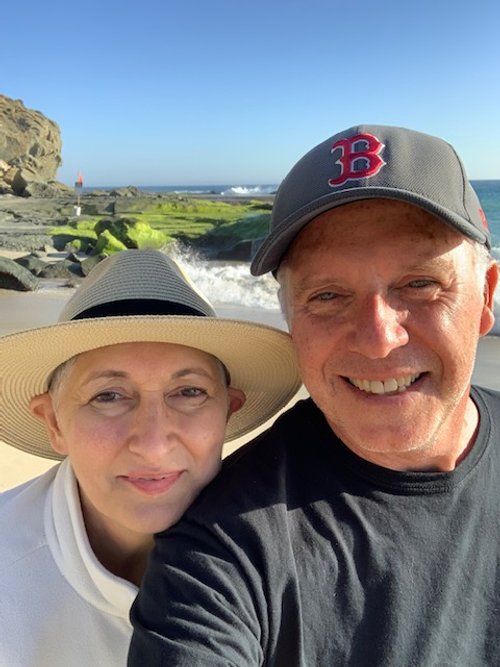
Interview with San Diego Voyager...Trailblazer!

Today we’d like to introduce you to May McGoldrick a.k.a. Nikoo Kafi McGoldrick.

Thanks for sharing your story with us, May. So, let’s start at the beginning and we can move on from there.

As you may know, I’m an immigrant. I came to the US on the eve of Iranian revolution in 1978. After my departure, the doors closed behind me.

I was a seventeen-year-old with big dreams of someday becoming a writer, but I also had a sense of reality. I knew I had to pay my own bills. I’d have to carve my own path. I’d have to fight and scratch to survive. I had no family here to host me. No one to welcome me into their affectionate arms. No soft place to land if I failed.

So, I tucked away my dreams of writing and went to engineering school. Yes, I was very good at sciences. And one thing my parents had instilled me from a young age was self-esteem. There was nothing I couldn’t do.

Six years later… yes, it took me six years… I was working for a Fortune 500 company. First, I had to become proficient in the language and change majors a couple of times before settling on Mechanical Engineering.

What followed was marriage to the love of my life and the birth of two wonderful sons. That was when the dream of being a novelist came about again.

It was the spring of 1994, long before moving to sunny Southern California.

My husband and I and our two boys were paying our dues in the sub-zero climates of New England. For the tenth time in a month, ice and snow had coated our trees, our street, our walks, and even our windows. It was the stormiest winter in our marriage, both inside and out. Our sensitivity to one another—and our search for ourselves—had developed to a critical point as we continued to deal with high-profile jobs, our marriage, and our children.

So, here we were, snowbound and feeling…what? Some might have called it midlife crisis–but in our thirties? We knew we needed a change. We needed something more.

Well, those standing outside our life and looking in, thought we needed matching lobotomies. After all, from their vantage point, we had successful careers, a solid marriage, and a growing family. Change is bad, we could hear them say. If it ain’t broke, don’t fix it.

But even if it ‘weren’t broke,’ the wheels were definitely starting to wobble.

A lot of us have experienced the feeling. That nagging regret that you’ve never really pursued your dream. That panicky rush when you wake up thinking that you’ve missed something and that you might just be too late to find it. It’s the Hemingway Syndrome. That feeling you get in an airport that life is too short. If I just get on that plane, we think, in a few hours I could be in Paris, Nairobi, Key West, Tahiti, San Diego. Then I could take those photographs, paint those canvasses, write that novel…

The snow was still falling. The ice was coating everything.

Our feelings seemed to be calling us back to those years of childhood and adolescence, those times when we wondered what it is that we want to be when we grew up!

For as long as either of us could remember, we both wanted to be writers!

A few years prior to that winter, Jim had given up a successful career path as a manager in a shipyard. He wanted to pursue his dream of going back to school and getting his Ph.D. in English. He’d done that. I, on the other hand, had been tied into a career in engineering and then management. As a woman advancing successfully in a primarily male profession, I had a lot at stake. At the same time, being a storyteller at heart, I viewed writing as my true calling—as a dream that I would never be allowed to pursue. After all, as far as the world around me was concerned, I was the one with an analytical mind. What talent in the arts could I possibly possess?
But then, this was the snowiest winter of our marriage. Ice was everywhere, and even the firmest ground had become slippery and treacherous.

Another ice storm. Another day off. An ad in a writer’s magazine for a fiction contest. Two people sit downside by side at a computer keyboard. An afternoon of working and reworking some ideas for a short story. As it happened, it turned out pretty well. The ice began to melt.

A month later, we were talking to an agent about a novel we’d started writing. That was the first of forty-nine published novels… so far.

Great, so let’s dig a little deeper into the story – has it been an easy path overall and if not, what were the challenges you’ve had to overcome?

Smooth? Hardly.

A life in the arts and in writing means following a road filled with ruts and potholes so deep they can swallow you up.

To begin with, writing a story that others find worthy of reading is difficult. Getting published is nearly impossible. Then, when you think your writing career is rolling, everything implodes. Your editor leaves the company. The publisher closes down an imprint. Another publishing house swallows up your publisher.

How do I get over the disappointments that go with our chosen path? Jim and I live by these words…We write for the love of writing, just as we read for the love of reading. We say writing is our passion, the career is incidental.

Also, to succeed, I truly believe a writer has to continually work at her craft. Publication is a train stop and not the end of the line. Hard work plays a huge part in success. I can proudly say that I’ve spent more time in front of a computer than Bill Gates.

And I’ve made a living at it. Not as much as Bill Gates, though.  Not yet.

Please tell us about May McGoldrick Books.

As I said earlier, I’ve been writing novels for the past twenty-five years. Working with my husband and partner, I’ve written (as May McGoldrick) historical fiction, historical romance, young adult fiction, and nonfiction. As Jan Coffey, we’ve also written political and military suspense, romantic suspense, mystery, and contemporary young adult fiction. I’m a USA Today Bestselling Author, and I’ve made the NY Times Extended Bestseller list. My novels have been translated into dozens of languages and published worldwide.

What sets me apart from a lot of other successful writers is that I came to this country when I was seventeen. I learned the language, got an education, and now I’m writing novels in my second language. The other thing that is a little different is that I write with my husband, and both of us have lived to talk about it.

Are there any apps, books, podcasts or other resources that you’ve benefited from using?

I’m a voracious reader, so it would be difficult to pick out any one book or podcast or blog specifically. But I would say is that I’m a true believer in the power of journaling during difficult times.

Julia Cameron’s book, The Artist’s Way, has provided a morning ritual for me every time life becomes difficult. I have volumes on my shelf from the times I was going through everything from cancer and depression to publishers failing to renew contracts. Writing during difficult times, however, is a reminder to me that in my heart and soul, I’m always a writer. This is what I love to do.

Words make me happy, and putting them on the page is one thing that I can control, even if the rest of my world is spinning off its axis. I can go on and on about the positive effects of journaling. Of course, not everyone can do it or wants to do it. My writing partner thinks of it as torture.

Five Kick-Ass Women from History: FreshFiction Blog

When we set out to write the Royal Highlander series (Highland Crown, Highland Jewel, Highland Sword), our goal was to weave the lives of three extraordinary women into the fabric of a revolutionary, but largely forgotten series of historical events called the Radical War of 1820.

From that mindset, the characters of Isabella, a university-trained physician; Maisie, an early activist for suffrage; and Morrigan, a militant revolutionary, formed in our imagination. Our research directed us to real historical figures of the Georgian and Regency Era who served as models for our heroines. Women like Dorothea Erxleben, physician; Mary Fildes, political activist and an early suffragette; ‘William’ Brown (birth name unknown), an African woman serving in the Royal Navy); and María Antonia Santos Plata, a rebel guerrilla leader in South America.

Since Highland Crown deals with a neglected chapter in Scotland’s struggle against the English Crown, we thought we’d cast a little light on five real life kick-ass heroines from the recent and distant past. These are rebellious and radical women who would never be talked about, if some people had their way. 

1.      Abigail Adams (1744-1818). Her husband might have been the second president of the United States, but she was a radical and a patriot from the earliest days of the Revolutionary War. With battles raging in the Boston area where she lived, Adams learned that the American soldiers were running low on ammunition. Gathering together all the silver and iron in her home, she had it melted down into bullets for the troops. She was also one of the first women to fight for women’s suffrage, famously telling her husband while he was off helping create the Constitution that it was a mistake to “put such unlimited power into the hands of [men]. Remember all men would be tyrants if they could.” And she believed in acting according to one’s principles; she wouldn’t step foot in the house of a slaveholder nor entertain one at her own table.

2.      Shirley Chisholm (1924-2005). In 1968, this fierce Brooklynite was the first African-American woman elected to Congress. Over the next fifteen years, she introduced over fifty pieces of legislation, fighting hard for gender and racial equality and serving as a champion throughout her life to improve conditions and opportunities for the poor. In 1972, Chisholm sought the Democratic nomination for President. When she was prevented from taking part in televised debates, she was not about to be bullied or ignored. She took legal action. When she was asked how she wanted to be remembered, ‘Fighting Shirley’ said, “I want to be remembered as a woman…who dared to be a catalyst of change.”      

3.      Nusaybah Bint Ka'ab (7th century) was a woman who would give any historical hero a run for their money. Nusaybah was one of the first people to convert to Islam. Born in Medina, she fought in seven battles against the warring neighbors, carrying a sword and bow and sustaining a dozen wounds, including the loss of one hand. But that didn’t stop her. In one battle, she distinguished herself as a fierce and tireless fighter, defending the Prophet (pbuh) himself against attacking warriors. She was tremendously revered by the community for her toughness as well as her goodness.

4.      Zitkála-Šá (1876–1938), which translates from Lakota into English as ‘Red Bird’, was a Dakota Sioux woman who fought her entire life against a white majority culture that was systematically trying to stamp out Native American identities. She battled racism and corruption in government and industry across the country, founding the National Council of American Indians to lobby for justice and equal rights. She wrote dozens of influential essays and pamphlets to expose American corporations that were using coercive business practices that included robbery and even murder to defraud tribes of their rights to leasing fees for development of their oil-rich land in Oklahoma. Her brilliance and tireless activism would lead to Congress passing the Indian Reorganization Act in 1934. And in her ongoing campaign to enlighten Americans, she was among the first to publish traditional Native American stories for a widespread white readership. In those stories, she used fictionalized autobiographical material to take issue with what she saw as the evils of assimilation aimed at erasing her history and way of life. Multi-talented, accomplished, and tenacious, she was truly a kick-ass hero.

5.      Bella Abzug (1920-1998) was an unrelenting feminist and civil rights advocate who served in the US House of Representatives during the 1970s. Fierce and outspoken,  this daughter of immigrants fought anyone who believed women should remain on the political sidelines. During her years in Congress, Abzug introduced legislation demanding the withdrawal of American forces from Vietnam. She demanded an investigation into the competence of J. Edgar Hoover, the all-powerful director of the FBI. She was the first to call for the impeachment of Richard Nixon. She even fought her own party’s complicity in the political deal-making traditionally carried on in secret and passed legislation that has come to be known as the ‘sunshine law’, requiring that the business of government be carried out in the open. Abzug also introduced groundbreaking legislation aimed at increasing the rights of all citizens, including the gay and lesbian community. Unable to fault her on ethical grounds, her critics were reduced to attacking her strong personality. She didn’t care. Her fight was for the American people. Bella Abzug was the kick-ass predecessor of all the newly elected women tearing it up in Congress today. 

 Of course, there are thousands upon thousands more. Maybe we should write a book about them? Or three!